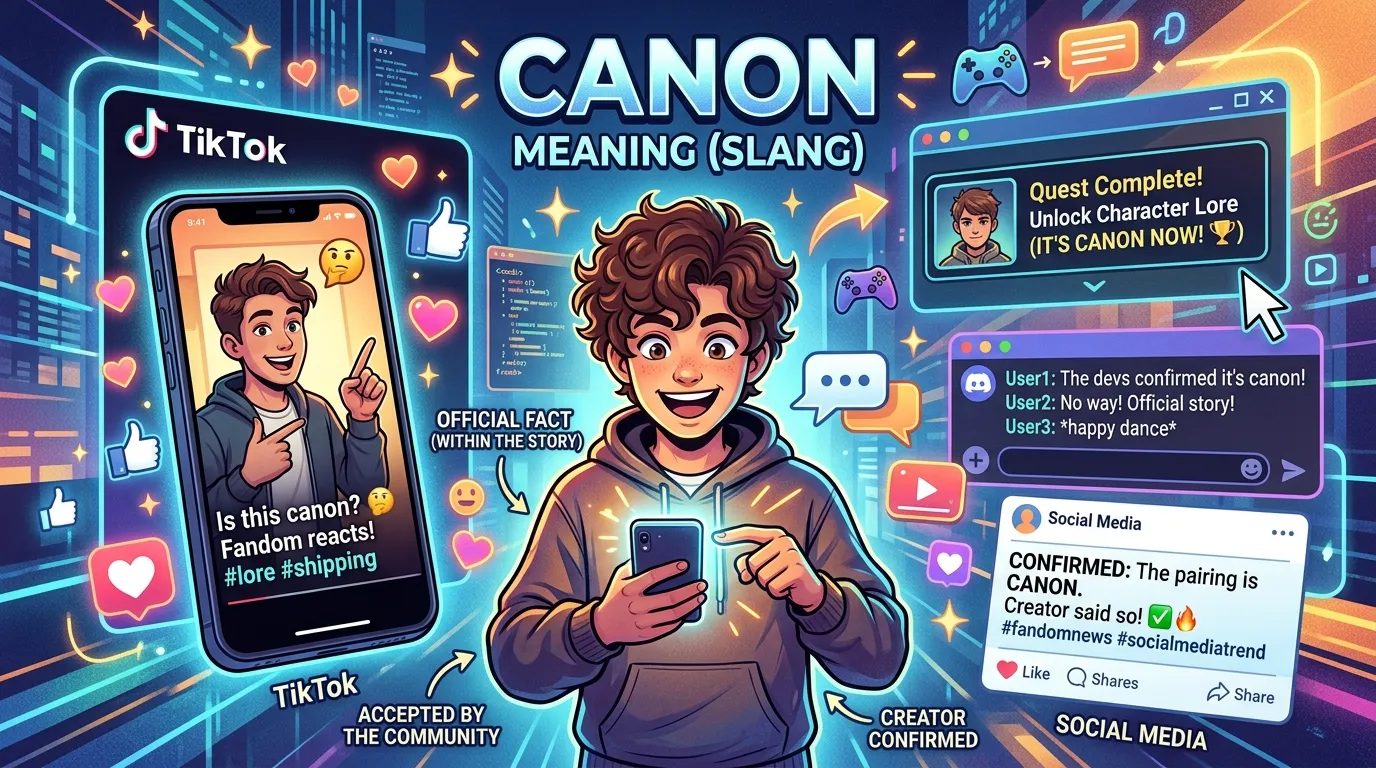
Have you seen someone say “That’s canon” in a TikTok comment, Discord chat, Reddit thread, or fandom discussion and wondered what they meant? The canon meaning slang uses a word that originally came from literature, religion, and storytelling but has become everyday internet language. Today, people use canon to describe something that is officially true within a fictional story, especially when discussing movies, TV shows, anime, books, video games, comics, and online fandoms.
In simple terms, “canon” means officially part of a story or accepted as true within its fictional universe. If a character really did something in the official story, fans may call that event canon. If the event comes from fan fiction, a meme, or an unofficial theory, it may be called non-canon instead.
The word has also developed playful uses online. Someone might joke, “It’s canon that I’m always late,” even though they are talking about their real life rather than a fictional universe. Understanding what canon means in slang, what canon means in texting, and how people use it on TikTok, Instagram, Discord, Reddit, and gaming platforms can make internet conversations much easier to follow.
What Does Canon Mean in Slang?
In modern internet slang, canon means something that is officially true, confirmed, or established within a fictional universe.
For example:
“Harry and Hermione being friends is canon.”
This means their friendship is officially shown in the story.
Another example:
“That relationship isn’t canon.”
This means the characters may be popular as a couple among fans, but the official story does not establish them as a romantic couple.
Canon meaning in one sentence
Canon = officially true or accepted as part of a story, fictional universe, or established narrative.
The term is especially common among fans of:
- Anime
- Manga
- Movies
- TV shows
- Comics
- Video games
- Books
- Superhero franchises
- Fantasy series
- Science fiction
- Online fandoms
However, internet users sometimes apply canon humorously to real-life events.
For example:
“My coffee addiction is officially canon.”
Here, the person is jokingly treating their real-life habit like part of a fictional character’s storyline.
Canon Meaning in Text Messages
When someone uses canon in a text message, they usually mean that something is officially established or genuinely happened within the story being discussed.
For example:
Person A: “Did the character actually kiss her?”
Person B: “Yes, it’s canon.”
The second person is saying that the kiss happened in the official story.
You may also see:
- “Is this canon?”
- “That’s canon.”
- “Not canon.”
- “Canon event.”
- “Canon relationship.”
- “Canon character.”
- “Canon ending.”
- “Canon ship.”
The exact meaning depends on context, but the basic idea remains officially established within the story.
Example text conversations
Example 1
“Did the game confirm that they are siblings?”
“Yep, it’s canon now.”
Example 2
“I thought that scene was fan-made.”
“Nope. It’s actually canon.”
Example 3
“Are they dating in the official story?”
“No. It’s a fan ship, not canon.”
Canon Meaning on TikTok
On TikTok, canon has become particularly popular because users frequently discuss fictional characters, fandom theories, edits, ships, and storylines.
You might see comments such as:
“This is so canon.”
or:
“Bro is canonically like this.”
In these situations, canon often means that the behavior fits the established personality or story of a character.
For example, a TikTok might show a fictional character constantly avoiding responsibility.
A commenter could write:
“Him running away is so canon.”
They mean that running away is completely consistent with the character’s established personality.
What is a “canon event”?
The phrase canon event became especially popular online after Spider-Man: Across the Spider-Verse.
A canon event is an important event that is considered necessary or established in a character’s story.
Internet users later began using the phrase humorously for real-life experiences.
For example:
“Getting your heart broken at least once is a canon event.”
The speaker is joking that heartbreak is an unavoidable part of growing up.
This is an example of how fandom terminology can move beyond its original context and become general internet slang.
Canon Meaning on Instagram
On Instagram, canon commonly appears in comments, captions, fan pages, Reels, and discussions about fictional characters.
For example:
“Their friendship is canon!”
or:
“This outfit is literally canon for her character.”
A fan account might post two characters together and someone could ask:
“Are they canon?”
The person is asking whether the official story confirms that the characters have the relationship shown in the post.
Canon vs fan-made content
Instagram has a huge amount of fan-created material, so distinguishing between canon and fanon can be important.
Canon refers to official material.
Fanon refers to ideas widely accepted or created by fans but not officially confirmed.
For example:
- A character’s official birthday = canon
- A fan-created birthday tradition = fanon
- An officially confirmed romance = canon
- A popular fan pairing = potentially fanon
Canon Meaning on Snapchat
On Snapchat, the word canon is less specialized than it is in fandom communities, but users can still use it when discussing movies, shows, games, or characters.
Someone might send a screenshot and ask:
“Is this canon?”
They are usually asking whether the event shown actually happened in the official story.
Because Snapchat conversations are often casual, the term may also be used jokingly.
For example:
“My terrible haircut is canon now.”
This playful use treats a real event as if it were part of someone’s fictional storyline.
Canon Meaning on Discord
Discord is one of the places where the slang meaning of canon is especially useful.
Fandom and gaming servers frequently have dedicated channels for:
- Lore
- Character discussion
- Story theories
- Roleplay
- Ships
- Game updates
- Alternate universes
- Fan fiction
A user might say:
“That’s not canon.”
They are correcting another person’s statement about the story.
Canon in Discord roleplay
In role-playing communities, canon can have an additional layer of meaning.
For example, a roleplay server might have established rules about what events are official within the server’s storyline.
Someone could say:
“That happened in our RP, so it’s canon.”
In this case, canon means officially part of the shared roleplay storyline.
Another user might create an alternate storyline that does not affect the main plot. That could be considered non-canon.
Canon Meaning on Reddit
Reddit fandom communities frequently use canon when debating fictional stories.
You may encounter questions like:
“Is this character canon?”
“Was that scene actually canon?”
“What’s the canon ending?”
“Is this theory canon?”
Reddit discussions can become quite detailed because users often compare:
- Original books
- Movies
- TV adaptations
- Interviews
- Official statements
- Comics
- Game content
- Spin-offs
This matters because different versions of the same story may have different forms of canon.
For example, something can be canon in a television adaptation but not in the original book.
Canon Meaning in Gaming
In gaming, canon refers to events, characters, locations, relationships, and lore officially recognized as part of the game’s story.
A player might ask:
“Is this ending canon?”
They want to know whether the game’s developers consider that ending part of the official storyline.
Common gaming examples
Canon character:
A character officially included in the game’s story.
Canon weapon:
A weapon officially belonging to the game’s universe.
Canon ending:
An ending recognized as part of the official storyline.
Canon event:
An event that officially occurs in the game’s lore.
Non-canon DLC:
Additional content that may not affect the main storyline.
Why gamers care about canon
Long-running games often contain complicated lore. Developers may release:
- Sequels
- Prequels
- Remakes
- Spin-offs
- DLC
- Alternate endings
- Reboots
As a result, players often ask which events are actually part of the official timeline.
Canon Meaning in Dating and Relationships
The word canon can also appear in dating discussions, especially when people talk about fictional relationships.
A canon couple is a romantic pairing officially established by the story.
For example:
“They aren’t just a popular ship. They’re canon.”
This means the relationship is officially confirmed.
By contrast, a ship can exist entirely because fans like the pairing.
Canon relationship vs fan ship
| Term | Meaning |
|---|---|
| Canon couple | Official romantic relationship |
| Fan ship | Pairing supported by fans |
| Non-canon couple | Relationship not officially established |
| Canon ship | Another way of saying officially recognized pairing |
| Fanon relationship | Fan-created or fan-accepted relationship |
This distinction is especially important in anime, manga, comics, and television fandoms.
Canon vs Fanon: What’s the Difference?
One of the most important related terms is fanon.
Canon is official.
Fanon is a fan-created or fan-supported idea that has become popular among a fandom.
For example, suppose a character never states that they hate spiders, but thousands of fans interpret their reactions as evidence that they do.
Eventually, people may talk about the character’s “fear of spiders” as if it were established.
Unless the creators confirm it, that idea remains fanon, not canon.
Simple comparison
| Canon | Fanon |
|---|---|
| Officially established | Created or accepted by fans |
| Supported by official material | Supported mainly by fandom |
| Part of the recognized story | May exist outside the official story |
| Usually confirmed by creators or source material | Often based on interpretation |
Canon vs Headcanon
Another term you’ll often see is headcanon.
A headcanon is a personal belief or interpretation that a fan considers true in their own understanding of a character or story.
For example:
“My headcanon is that this character loves cooking.”
The official story may never mention it.
So:
Canon: The story officially says it.
Fanon: Many fans accept or promote it.
Headcanon: An individual fan personally believes it.
These terms are closely related but are not interchangeable.
Canon vs Non-Canon
Non-canon means something is not considered part of the official storyline.
For example:
“The movie is based on the characters, but that storyline isn’t canon.”
It may still be officially produced. That’s an important distinction.
Something can be made or released by a studio but later be treated as outside the main continuity.
Why does something become non-canon?
Possible reasons include:
- A reboot changes the timeline.
- A later story contradicts an earlier one.
- A spin-off exists outside the main continuity.
- Creators explicitly reject an earlier storyline.
- An alternate universe is introduced.
- A remake replaces older continuity.
What Does “Canon Event” Mean in Slang?
Canon event originally refers to a significant event within a fictional character’s established storyline.
Online, however, people often use it as humorous slang for an experience that feels inevitable or formative.
Examples include:
“Your first embarrassing school presentation is a canon event.”
“Everyone needs one terrible first job. It’s a canon event.”
“Getting obsessed with a band in high school was my canon event.”
The phrase usually carries a playful, dramatic, or ironic tone.
It does not necessarily mean the event is literally unavoidable.
What Does “Canonically” Mean?
Canonically means according to the official story or established facts.
For example:
“Canonically, he is the youngest member of the group.”
This means the official story confirms that fact.
Online users sometimes use it humorously:
“Canonically, I cannot function without coffee.”
Here, the speaker is pretending their coffee habit is an established fact about their personal character.
Canon vs canonically
Canon is commonly used as a noun or adjective:
“That relationship is canon.”
Canonically is an adverb:
“Canonically, they have known each other since childhood.”
Canon Meaning in Anime and Manga
Anime and manga communities use canon constantly.
Fans may debate whether something comes from:
- The original manga
- Anime adaptation
- Filler episodes
- Movies
- Light novels
- Spin-offs
- Official guidebooks
- Creator statements
A manga event may be canon to the original source while an anime-only event may be considered non-canon to the manga continuity.
What is anime filler?
Filler generally refers to material added to an adaptation that does not come directly from the main source storyline.
However, filler and non-canon are not always perfectly identical terms. A viewer should check the specific franchise before assuming that every anime-original scene is irrelevant.
Canon Meaning in Movies and TV Shows
Movie and TV fandoms use canon to track continuity.
Consider a franchise with several films. If one movie contradicts another, fans may ask:
“Which version is canon?”
This question is especially common after:
- Reboots
- Remakes
- Sequels
- Spin-offs
- Alternate timelines
- Retcons
What is a retcon?
Retcon means “retroactive continuity.”
It happens when a later story changes, reinterprets, or adds information to something established earlier.
For example, a character might originally be presented as an only child. A later installment could introduce a previously unknown sibling.
Fans may then debate whether the new information changes the old canon.
The Origin and History of the Word Canon
The word canon is much older than internet slang.
It comes from a Greek word associated with a rule, standard, or measuring principle. Over time, the term developed several meanings.
It became associated with authoritative collections of religious writings and later with accepted bodies of literature.
The literary meaning eventually developed into the idea of works or stories that are considered authoritative or officially recognized.
Modern fandom adopted this concept because fictional universes also have their own official body of stories and facts.
The internet then made the term even more common.
Today, people can discuss canon instantly through:
- Social media
- Wikis
- Discord
- TikTok
- YouTube
- Fan forums
- Gaming communities
The meaning stayed broadly the same, but its use became much more casual.
Why Has Canon Become Popular Internet Slang?
The popularity of canon reflects the growth of online fandom culture.
Modern franchises can have enormous amounts of content. Fans don’t simply watch a movie or play a game anymore. They analyze timelines, character relationships, hidden clues, interviews, deleted scenes, and creator comments.
This creates a need for vocabulary that separates official information from fan interpretation.
Words such as:
- Canon
- Fanon
- Headcanon
- Non-canon
- Retcon
- Lore
- AU
- Ship
- OC
help fandoms communicate complicated ideas quickly.
Common Real-Life Examples of Canon Slang
The word has also escaped traditional fandom conversations.
Here are some humorous examples.
Example 1: Personal habits
“My obsession with pizza is canon.”
Meaning: The speaker jokingly treats their pizza obsession as an established part of their personality.
Example 2: Friendship
“Us getting lost on every road trip is canon.”
Meaning: It happens so often that the friends jokingly consider it part of their shared story.
Example 3: School
“Failing one exam before graduation is a canon event.”
Meaning: The speaker is joking about a common life experience.
Example 4: Dating
“The awkward first date was definitely a canon event.”
Meaning: The awkward experience is being framed humorously as an important part of the person’s personal story.
Is “Canon” Positive or Negative?
Usually, canon is neutral.
The word itself does not automatically indicate that something is good or bad.
For example:
“Their breakup is canon.”
That statement simply means the breakup is officially part of the story.
However, tone can change depending on the surrounding language.
Positive use
“Finally! They’re canon!”
This expresses excitement that a relationship has become official.
Negative use
“Unfortunately, that ending is canon.”
This suggests the speaker dislikes an official story decision.
Humorous use
“My inability to wake up early is canon.”
This is playful and self-deprecating.
Common Mistakes When Using Canon
Because canon has a specific fandom meaning, people sometimes misuse it.
Mistake 1: Calling every official product canon
An officially released product isn’t necessarily part of the main continuity.
A spin-off can be officially licensed while still existing outside the primary storyline.
Mistake 2: Confusing canon with fanon
A popular fan theory does not automatically become canon.
Popularity among fans and official confirmation are different things.
Mistake 3: Confusing canon with headcanon
Your personal interpretation can be meaningful without being officially established.
Calling a headcanon “canon” can confuse other fans.
Mistake 4: Assuming canon never changes
Long-running franchises can change their continuity.
A reboot or retcon may alter what fans previously considered established.
Canon, Lore, Continuity, and Headcanon Compared
These words are related but have different meanings.
| Term | Meaning |
|---|---|
| Canon | Officially established story facts |
| Lore | The broader background and history of a fictional world |
| Continuity | How events and details fit together over time |
| Fanon | Ideas commonly accepted by fans |
| Headcanon | A fan’s personal interpretation |
| Non-canon | Material outside the recognized official storyline |
| Retcon | A later change to established continuity |
| AU | Alternate universe or alternate version of the story |
| Ship | A fan-supported romantic pairing |
Knowing these distinctions makes fandom discussions much easier.
How to Tell Whether Something Is Canon
If you’re unsure whether an event or character is canon, try these steps:
- Check the original source.
Look at the official book, manga, game, movie, or show. - Look for creator confirmation.
Statements from the creators can clarify disputed details. - Check official franchise materials.
Official guides and websites may provide continuity information. - Separate fan theories from confirmed facts.
A popular Reddit post is not automatically official. - Watch for continuity changes.
Reboots and retcons can change established information. - Check the specific continuity.
One adaptation may have different canon from another.
This last point is important. A fact can be canon in one version of a franchise but not another.
Is Canon the Same as “Official”?
Not always.
In casual conversation, people often use canon and official almost interchangeably. But fandom discussions can be more complicated.
Something may be:
- Officially produced
- Officially licensed
- Officially published
- Canon to the main storyline
- Canon to an alternate continuity
These aren’t necessarily the same thing.
For precise discussions, canon usually means that the information belongs to the recognized continuity of that particular story.
Is Canon Still Popular Slang in 2026?
Yes. Canon remains a common fandom and internet term, especially in communities centered around anime, gaming, comics, movies, television, and fictional universes.
Its popularity is also reinforced by phrases such as:
- “Canon event”
- “That’s canon”
- “Canonically”
- “Not canon”
- “Canon ship”
- “Canon character”
- “Canon ending”
- “My headcanon”
- “Fan canon”
Social platforms have helped turn what was once specialized fandom vocabulary into language that many casual internet users recognize.
Quick Summary: Canon Meaning Slang
| Category | Details |
|---|---|
| Primary meaning | Officially established as true within a story |
| Canon slang meaning | Something considered officially true or part of the storyline |
| Origin | Ancient Greek term associated with a rule or standard |
| Common platforms | TikTok, Reddit, Discord, Instagram, Snapchat, X, YouTube |
| Common communities | Anime, gaming, movies, TV, comics, books |
| Tone | Usually neutral; often humorous online |
| Opposite | Non-canon |
| Related term | Fanon |
| Personal interpretation | Headcanon |
| Important phrase | Canon event |
| Adverb | Canonically |
| Relationship use | An officially established romantic pairing |
Frequently Asked Questions
What does “canon” mean in texting?
In texting, canon usually means officially true or established within a fictional story. If someone says “That’s canon,” they are generally saying that the event, character detail, or relationship is officially part of the story.
What does “that’s canon” mean on TikTok?
On TikTok, “that’s canon” means something is officially established in a fictional universe. It can also be used humorously to describe a person’s behavior as though it were part of their fictional character storyline.
What is a canon event in slang?
A canon event is an important event that is part of a character’s established story. Online, people often use the phrase jokingly for memorable, difficult, embarrassing, or formative real-life experiences.
What does “canonically” mean on social media?
Canonically means “according to the official story.” For example, “Canonically, they are siblings” means the official source confirms that the characters are siblings.
What is the difference between canon and fanon?
Canon is officially established, while fanon consists of ideas created or widely accepted by fans. A fan theory can become extremely popular without becoming canon.
What does “not canon” mean?
Not canon means that something is not considered part of the official storyline or recognized continuity. It may still be official content, fan-created material, an alternate universe, or a separate interpretation.
What does canon mean in anime?
In anime, canon refers to events, characters, relationships, and information officially recognized as part of the story’s continuity. Fans sometimes distinguish between manga canon, anime-original material, filler, and other continuities.
What does canon mean in gaming?
In gaming, canon means that a character, event, ending, location, or piece of lore is officially part of the game’s recognized story. Players often use the term when discussing complicated timelines or alternate endings.
Can something be canon and fanon at the same time?
A concept can begin as fanon and later become canon if the creators officially establish it. Until that happens, popularity among fans alone does not make something canon.
What does “my headcanon” mean?
“My headcanon” means a personal belief or interpretation about a fictional character or story that may not be officially confirmed. It is essentially the version of the story that a particular fan imagines or accepts personally.
Final Takeaway
The simplest canon meaning slang is “officially true within a fictional story or universe.” When someone says “that’s canon,” they usually mean the source material confirms it.
The term is especially common in anime, gaming, movies, TV shows, comics, books, TikTok, Reddit, Discord, and other fandom communities. You may also encounter related expressions such as canon event, canonically, canon ship, fanon, headcanon, non-canon, and retcon.
The key distinction is easy to remember:
Canon = official.
Fanon = fan-created or fan-accepted.
Headcanon = personal fan interpretation.
Non-canon = outside the recognized storyline.
Once you understand that basic difference, phrases like “Is this canon?”, “They’re canon,” and “That’s my headcanon” become much easier to understand. And when someone jokes that an embarrassing moment was their “canon event,” they’re simply borrowing fandom language to describe an experience that feels like an important part of their personal story.