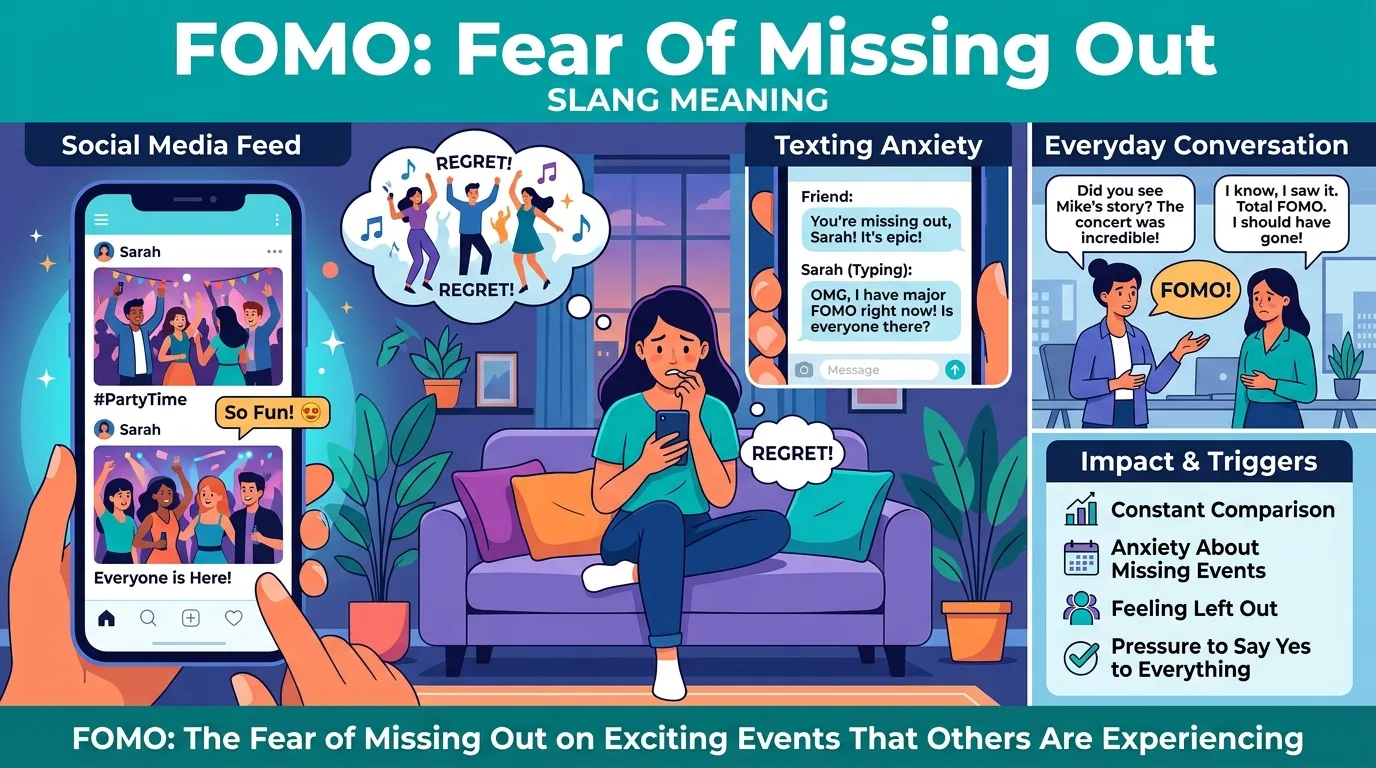
Have you ever seen your friends posting pictures from a party you skipped and suddenly wished you had gone? That feeling has a name: FOMO. The FOMO meaning slang refers to the fear of missing out, or the uneasy feeling that other people are enjoying something exciting, important, or valuable without you.
Today, FOMO is one of the most common slang abbreviations used in text messages, social media, TikTok, Instagram, Snapchat, Reddit, Discord, gaming, dating, and everyday conversations. Someone might text, “I have major FOMO right now,” or comment, “FOMO made me go,” when they feel anxious about being left out.
But FOMO is more than just wanting to attend a party. It can describe pressure to join social events, buy something before it sells out, watch a trending show, participate in an online conversation, or keep up with friends. It can even influence decisions at work, in relationships, and in personal spending.
Understanding what FOMO means, how people use it, and how it differs from similar expressions can help you communicate naturally online and offline. This guide explains everything from the basic FOMO definition to its history, examples, emotional meaning, modern usage, related slang, and practical ways to recognize it.
What Does FOMO Mean in Slang?
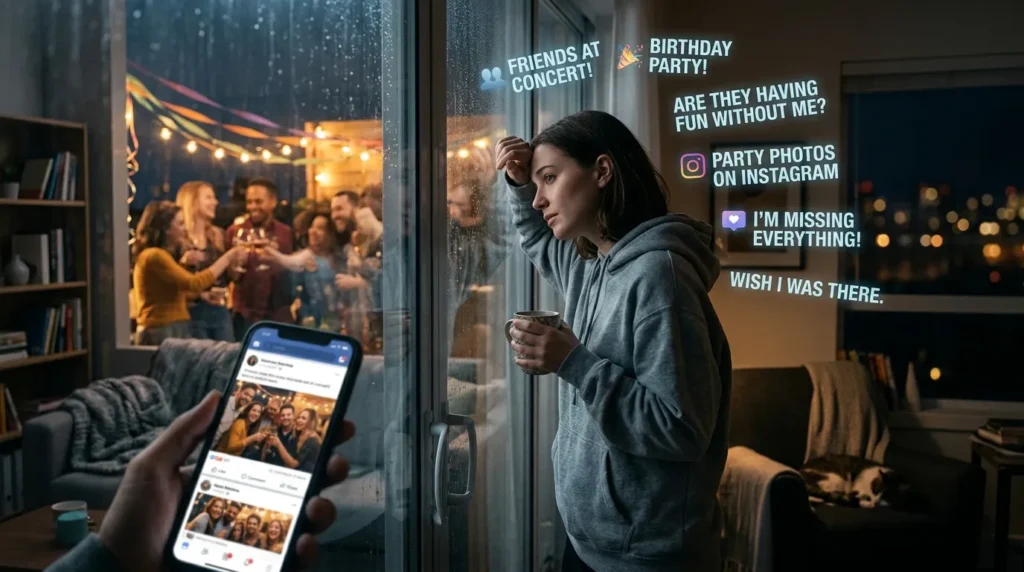
FOMO means “fear of missing out.”
It describes the feeling that you might miss an enjoyable, exciting, useful, or important experience while other people are participating without you.
Simple FOMO Definition
FOMO = Fear of Missing Out
In everyday slang, FOMO usually describes a mixture of:
- Anxiety about being left out
- Curiosity about what others are doing
- A desire to participate
- Regret about skipping something
- Social pressure to join an activity
- Concern that you are missing an important opportunity
For example:
“I wasn’t going to the concert, but my FOMO got the best of me.”
This means the person originally planned to skip the concert but became worried they would regret missing it.
Another example is:
“Everyone is hanging out tonight. I’m getting serious FOMO.”
Here, the speaker feels left out because other people are having fun without them.
What Does FOMO Mean in Texting?
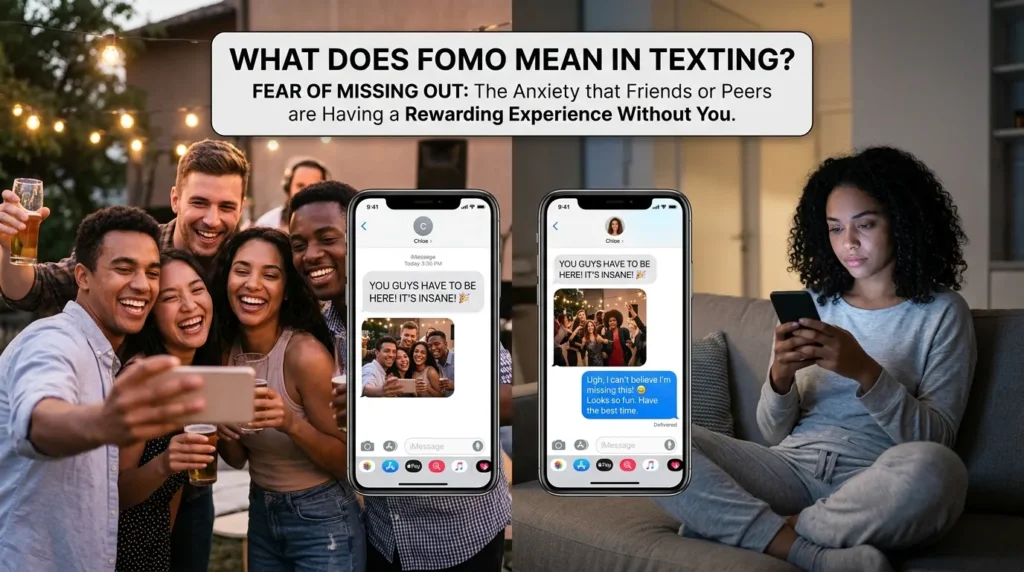
In texting, FOMO is a quick way to say that you feel left out or worried about missing something.
Because FOMO is widely understood, people rarely need to spell out fear of missing out in casual messages.
Examples of FOMO in Text Messages
Friend: Are you coming to dinner tonight?
You: Probably not. But I’m already getting FOMO 😂
The speaker expects to stay home but is beginning to regret that decision.
Another example:
“Everyone’s going to the beach tomorrow. FOMO is hitting hard.”
This means the person wishes they could join.
You might also see:
- “I have FOMO.”
- “Major FOMO rn.”
- “My FOMO made me go.”
- “Don’t give me FOMO!”
- “This picture is giving me FOMO.”
- “FOMO is real.”
- “I’m staying home because I’m tired, but I already have FOMO.”
The abbreviation works especially well in casual conversations because it communicates a complicated feeling with only four letters.
What Does FOMO Mean on Social Media?
On social media, FOMO often appears when people see posts, stories, videos, or photos showing experiences they are not part of.
Instagram, TikTok, Snapchat, Facebook, Reddit, and other platforms can make FOMO particularly noticeable because users constantly see highlights from other people’s lives.
For example, someone might open Instagram and see:
- Friends at a concert
- A group vacation
- A birthday party
- A popular restaurant
- A sold-out event
- A new product everyone owns
- A trending challenge
- A major social gathering
They might comment:
“Okay, this is giving me FOMO.”
The person is saying that the post makes them wish they were there.
FOMO on Instagram
Instagram FOMO often comes from photos and Stories.
For example:
“Everyone looks like they’re having the best weekend. FOMO!”
The statement does not necessarily mean the person’s life is bad. It simply means they wish they were participating in what they are seeing.
FOMO on TikTok
TikTok can create FOMO around trends, events, products, travel destinations, restaurants, and experiences.
For example:
“TikTok convinced me I need to visit this place. The FOMO is confused.”
The speaker sees many people enjoying something and feels motivated to experience it too.
FOMO on Snapchat
Snapchat can create a particularly strong sense of FOMO because users often post real-time updates.
A person might see their friends at a gathering and say:
“Why did I stay home? FOMO 😭.”
FOMO on Reddit
On Reddit, FOMO may appear in discussions about hobbies, games, technology, entertainment, investing, events, or online communities.
For example:
“Everyone is talking about this game, and now I have FOMO.”
What Does FOMO Mean on Discord?
On Discord, FOMO is commonly used when someone misses an online event, gaming session, voice chat, community activity, or group conversation.
For example:
“You guys played without me? FOMO 😭.”
Or:
“I had to work tonight, and now I have major FOMO seeing everyone in VC.”
Here, VC means voice chat.
Discord FOMO can happen in gaming communities, friend groups, study servers, fandom communities, and other online groups.
What Does FOMO Mean in Gaming?
In gaming, FOMO can describe the fear of missing limited-time content or being left behind by other players.
Examples include:
- Limited-time events
- Seasonal rewards
- Exclusive skins
- Special challenges
- Time-limited items
- Multiplayer sessions
- New releases
- Competitive rankings
A gamer might say:
“I don’t even want the skin, but FOMO made me complete the event.”
The player participates mainly because the reward will not be available forever.
Another example:
“I bought the battle pass because I had FOMO.”
The speaker felt pressure to participate before the opportunity disappeared.
What Does FOMO Mean in Dating?
FOMO can also appear in dating conversations.
Someone might feel FOMO when they worry that they are missing opportunities to meet people, go on dates, or experience relationships.
For example:
“I’m happy being single, but sometimes dating apps give me FOMO.”
This suggests that seeing other people dating may create concern about missing out on romantic opportunities.
Another example:
“My friends are all in relationships, and I’m getting FOMO.”
In this context, FOMO is not necessarily about wanting a specific person. It may be about feeling left behind socially.
What Does FOMO Mean at Work?
FOMO is not limited to social situations.
At work, someone may experience FOMO when they worry about missing:
- A promotion
- An important meeting
- A networking opportunity
- A new project
- A career opportunity
- Industry trends
- A professional event
For example:
“I wasn’t planning to attend the conference, but I had FOMO about missing the networking opportunities.”
Here, FOMO describes concern about losing a potential professional advantage.
Workplace FOMO can sometimes encourage people to participate in useful opportunities. However, it can also make people feel pressured to say yes to everything.
FOMO in Everyday Conversation
FOMO is now common enough to appear in ordinary spoken English.
Someone might say:
“I almost stayed home, but I got FOMO.”
Or:
“Don’t send me pictures. You’re going to give me FOMO.”
The expression is usually casual and conversational.
It can be serious, humorous, exaggerated, or self-aware depending on the context.
Example of Humorous FOMO
“I wasn’t invited, but I’m experiencing FOMO from a party I didn’t even want to attend.”
The humor comes from recognizing the contradiction.
The person did not necessarily want to go but still dislikes feeling excluded.
FOMO Meaning: Summary Table
| Feature | Explanation |
|---|---|
| Slang | FOMO |
| Full form | Fear of Missing Out |
| Basic meaning | Anxiety or concern about missing an experience or opportunity |
| Common use | Texting, social media, conversations, gaming, dating, work |
| Tone | Casual, conversational, sometimes humorous |
| Typical emotion | Anxiety, curiosity, regret, excitement, social pressure |
| Common phrase | “I have FOMO” |
| Related expression | Fear of being left out |
| Opposite concept | JOMO, or joy of missing out |
| Common trigger | Seeing other people participate in something |
Where Did FOMO Come From?
The phrase fear of missing out existed as an idea before it became popular internet slang.
People have always experienced concern about being excluded from social events or opportunities. However, the modern term became increasingly recognized as social media and always-connected technology changed how people interacted.
The abbreviation FOMO eventually became a convenient way to describe this familiar psychological and social experience.
The rise of smartphones and social platforms made the feeling more visible because people could constantly see what others were doing.
Before social media, you might hear about a party the next day.
Today, you can watch it happen through Stories, posts, livestreams, group chats, and short videos.
That constant access helped turn FOMO into a widely recognized expression.
How FOMO Became Popular Online
Modern internet culture gave FOMO a much larger role.
People no longer have to wait to discover what they missed. They can see it immediately.
For example:
- Your friends attend an event.
- They post photos and videos.
- You see those posts from home.
- You start imagining how much fun they are having.
- You regret not going.
- You experience FOMO.
This cycle can happen within minutes.
Social media also creates a stream of opportunities that appear endless. There is always another event, trend, product, trip, gathering, or conversation to join.
That makes FOMO especially relevant to modern digital culture.
Why Do People Experience FOMO?
FOMO can come from several different emotions.
Social Belonging
Humans generally want to feel connected to other people.
When someone sees their friends having fun without them, they may feel excluded.
Curiosity
Sometimes FOMO is simply curiosity.
You may wonder:
“What am I missing?”
That question alone can make you want to participate.
Regret
FOMO can also involve anticipated regret.
You may think:
“What if this turns out to be amazing and I don’t go?”
Comparison
Social media encourages people to compare their experiences with what others show online.
Even when the comparison is unrealistic, it can still create FOMO.
Opportunity
FOMO can be about more than fun.
Someone may worry about missing a career opportunity, an important conversation, a limited product, or a valuable experience.
FOMO vs. JOMO
One of the most interesting comparisons is FOMO vs. JOMO.
JOMO means joy of missing out.
While FOMO describes anxiety about missing something, JOMO describes feeling comfortable and even happy about choosing not to participate.
| FOMO | JOMO |
|---|---|
| Fear of missing out | Joy of missing out |
| Focuses on what you are missing | Focuses on what you gain by staying away |
| Can create anxiety | Can create peace |
| Often involves social pressure | Often involves intentional choice |
| “I wish I were there.” | “I’m glad I stayed home.” |
For example:
FOMO: “Everyone is going out tonight. I should probably go.”
JOMO: “Everyone is going out tonight, but I’m enjoying a quiet evening at home.”
JOMO does not mean someone dislikes people. It simply means they are comfortable choosing their own priorities.
FOMO vs. YOLO
FOMO and YOLO are related but different.
YOLO means you only live once.
YOLO often encourages someone to take an opportunity because life is short.
FOMO is driven more by the fear that others are experiencing something without you.
For example:
YOLO: “I’m booking the trip. You only live once!”
FOMO: “Everyone is booking the trip, and I don’t want to miss out.”
The first focuses on making the most of life.
The second focuses on the possibility of being left out.
FOMO vs. Peer Pressure
FOMO and peer pressure can overlap, but they are not identical.
Peer pressure happens when other people influence you to behave in a certain way.
FOMO is the internal feeling that you might be missing something.
For example:
Peer pressure: “My friends keep telling me I have to go.”
FOMO: “Nobody told me to go, but I feel like I should because everyone else is going.”
The difference is important.
FOMO can exist even when nobody directly pressures you.
Is FOMO Positive or Negative?
FOMO can have both positive and negative effects.
Positive FOMO
Sometimes FOMO encourages people to try something new.
It might motivate you to:
- Attend a useful event
- Spend time with friends
- Explore a new hobby
- Travel
- Meet new people
- Take advantage of an opportunity
- Participate in a community
For example, you might almost skip a social gathering but decide to attend because you realize you would genuinely enjoy seeing your friends.
Negative FOMO
FOMO becomes problematic when it repeatedly causes anxiety or poor decisions.
It can encourage:
- Overspending
- Overcommitting
- Constant social media checking
- Lack of sleep
- Impulsive decisions
- Unnecessary purchases
- Social comparison
- Difficulty enjoying the present moment
The key issue is whether you are making a choice because you genuinely want something or because you are afraid of being left out.
Common FOMO Phrases and What They Mean
“I have FOMO.”
You feel like you are missing something.
“Major FOMO.”
You strongly feel that you are missing out.
“FOMO is real.”
The speaker acknowledges that the fear feels genuine or powerful.
“You’re giving me FOMO.”
Something someone said, showed, or posted makes you wish you were participating.
“My FOMO made me go.”
The fear of missing something convinced the person to participate.
“Don’t give me FOMO.”
A playful request not to show or describe something that might make the speaker feel left out.
“FOMO got me.”
The person gave in to the urge to participate.
Real-Life FOMO Examples
Example: Party
Alex: I’m staying home tonight.
Jordan: We’re all going to that new rooftop place.
Alex: Okay, now I have FOMO. I’ll come.
Here, seeing the plan changed Alex’s decision.
Example: Concert
Mia: I skipped the concert.
Sam: It was incredible!
Mia: Please stop. You’re giving me FOMO.
The photos or description make Mia regret skipping it.
Example: Shopping
Alex: Are you buying those shoes?
Taylor: I wasn’t going to, but they’re almost sold out.
Alex: That’s FOMO talking.
Here, scarcity creates pressure.
Example: Gaming
Player 1: We’re running the event tonight.
Player 2: I can’t play.
Player 1: We’re getting the limited rewards.
Player 2: Great. Now I have FOMO.
The limited-time reward increases the fear of missing out.
Common Misconceptions About FOMO
FOMO Does Not Always Mean Jealousy
Someone can experience FOMO without being jealous.
They may simply wish they were participating.
FOMO Is Not Always Serious
People often use FOMO jokingly.
Someone may say:
“My friends went for pizza without me. I have FOMO.”
That does not necessarily indicate serious emotional distress.
FOMO Is Not Only About Parties
FOMO can involve:
- Travel
- Work
- Shopping
- Dating
- Gaming
- Entertainment
- Food
- Hobbies
- Online communities
- Education
- Career opportunities
FOMO Does Not Mean You Actually Missed Something Important
Sometimes people use FOMO dramatically for something minor.
The expression can simply add humor to a conversation.
How to Use FOMO Correctly
Use FOMO when you want to describe a casual fear, concern, regret, or desire related to missing out.
It works naturally in:
- Text messages
- Social media comments
- Captions
- Group chats
- Online communities
- Casual conversations
Natural Examples
“I have FOMO seeing everyone’s vacation pictures.”
“This event is giving me serious FOMO.”
“I wasn’t going to buy it, but FOMO got me.”
“Don’t give me FOMO while I’m stuck at work.”
These examples sound natural because the context clearly involves missing out.
When Should You Avoid Using FOMO?
FOMO is informal slang.
You should generally avoid it in highly formal writing unless you are discussing the term itself.
For example, instead of writing:
“The employee experienced FOMO.”
in a formal report, you might write:
“The employee expressed concern about missing an important professional opportunity.”
In casual communication, however, FOMO is perfectly natural.
FOMO in Modern Internet Culture
FOMO has become closely connected with digital life.
People can see what others are doing almost constantly.
A single scroll through social media can expose someone to:
- Someone else’s vacation
- A friend’s dinner
- A concert
- A new relationship
- A career achievement
- A new purchase
- A gaming event
- A trending experience
This creates a strange modern situation: you can feel like you are missing something even when you were perfectly satisfied a few minutes earlier.
That is one reason FOMO slang remains so relevant.
FOMO and Limited-Time Offers
FOMO is also common in marketing language.
Phrases such as:
- Limited time
- Almost sold out
- Last chance
- Ending tonight
- Exclusive access
- Only a few left
can create urgency.
The underlying message is:
“If you wait, you may miss your chance.”
This is closely related to the emotional idea behind FOMO.
However, not every limited-time offer represents a genuine opportunity. Recognizing FOMO can help consumers pause and decide whether they actually want something.
How to Avoid Unnecessary FOMO
You do not have to eliminate every feeling of FOMO.
Instead, learn to question it.
Ask yourself:
- Do I actually want this?
- Would I want it if nobody else were doing it?
- Am I making this decision because I feel pressured?
- Will this matter to me next week?
- Can I afford the money or time involved?
- Am I comparing my everyday life with someone else’s highlight reel?
These questions can turn an emotional reaction into a thoughtful decision.
What Is the Opposite of FOMO?
The closest popular opposite is JOMO, meaning joy of missing out.
JOMO is the ability to enjoy your own choice even when other people are doing something different.
For example:
“Everyone is going out, but I’m staying home with a movie. JOMO.”
The idea is simple: you do not have to participate in everything to have a fulfilling life.
Sometimes missing out is exactly what you need.
Related Slang and Expressions
Several expressions are connected to FOMO.
FOMO
Fear of missing out.
JOMO
Joy of missing out.
YOLO
You only live once.
Left Out
Feeling excluded from a group or activity.
In the Loop
Being informed about what is happening.
Out of the Loop
Not knowing what others know or discuss.
Keeping Up
Trying to stay current with other people or trends.
Peer Pressure
Influence from people in your social group.
These expressions overlap, but each has a slightly different meaning.
FOMO in a Sentence
Here are several natural examples:
- “I have FOMO because everyone went without me.”
- “That vacation photo is giving me FOMO.”
- “My FOMO convinced me to buy tickets.”
- “I wasn’t interested until I saw everyone talking about it.”
- “Don’t give me FOMO while I’m working.”
- “I stayed home, but now I have major FOMO.”
- “The limited edition release triggered my FOMO.”
- “I think I’m choosing this because of FOMO.”
FOMO Meaning in Different Contexts
| Context | Typical Meaning |
|---|---|
| Texting | Feeling left out or worried about missing something |
| Wanting an experience shown in a post or Story | |
| TikTok | Feeling pressure to try a trend, place, product, or experience |
| Snapchat | Regretting missing a real-time social activity |
| Discord | Missing online conversations, events, or gaming sessions |
| Feeling behind on discussions, hobbies, games, or trends | |
| Gaming | Fear of missing limited content or rewards |
| Dating | Fear of missing romantic opportunities |
| Workplace | Concern about missing career or networking opportunities |
| Everyday speech | Casual fear or regret about missing out |
Why FOMO Is So Widely Used
FOMO became popular because it gives people a simple label for a complicated modern emotion.
Instead of explaining:
“I’m worried that everyone else is having a good time and that I made the wrong decision by staying home.”
you can simply say:
“I have FOMO.”
Four letters communicate the idea quickly.
That efficiency is one reason abbreviations like FOMO work so well in texting and online communication.
Is FOMO Still Slang?
Yes, but it has become more widely recognized than many short-lived internet slang terms.
FOMO can still be described as informal slang, but its meaning is familiar to many English speakers.
It is used in casual speech, digital communication, media discussions, marketing conversations, and professional discussions about consumer or social behavior.
Its popularity has made it more than a niche internet abbreviation.
Frequently Asked Questions
What does FOMO stand for?
FOMO stands for fear of missing out. It describes anxiety, curiosity, or regret caused by the feeling that other people are enjoying an experience or taking advantage of an opportunity without you.
What does FOMO mean on social media?
On social media, FOMO means feeling that you are missing something after seeing other people participate in an activity, attend an event, travel, buy something, or experience something enjoyable.
What does “I have FOMO” mean?
“I have FOMO” means “I feel like I am missing out.” It can describe genuine concern or playful regret about not participating in something.
What does “you’re giving me FOMO” mean?
“You’re giving me FOMO” means that someone’s story, photo, video, or description is making you wish you were experiencing the same thing.
Is FOMO a bad thing?
Not necessarily. FOMO can motivate someone to participate in meaningful activities, but it can become negative when it causes anxiety, impulsive spending, overcommitment, or constant comparison with others.
What is the opposite of FOMO?
The popular opposite of FOMO is JOMO, which means joy of missing out. JOMO describes feeling comfortable or happy with choosing not to participate.
Is FOMO the same as jealousy?
No. FOMO can involve jealousy, but they are not identical. FOMO focuses on the fear of missing an experience or opportunity, while jealousy usually involves concern about losing something or someone to another person.
Can FOMO be used in professional communication?
It can be used in casual workplace conversations, but it may sound too informal in formal reports or official documents. In formal writing, phrases such as “concern about missing an opportunity” may be clearer.
Why does social media cause FOMO?
Social media constantly exposes people to selected moments from other people’s lives. Seeing events, achievements, purchases, and experiences can make someone feel that others are enjoying opportunities they are missing.
What is the difference between FOMO and YOLO?
FOMO means fear of missing out, while YOLO means you only live once. FOMO is usually driven by concern about missing something, while YOLO is often used to justify taking a risk or enjoying an opportunity.
Final Thoughts
The FOMO meaning slang is simple: FOMO stands for fear of missing out. It describes the feeling that you might be missing an exciting, valuable, social, or important experience while other people are taking part.
You will commonly see FOMO in texts, social media posts, TikTok comments, Instagram captions, Snapchat messages, Discord chats, Reddit discussions, gaming communities, dating conversations, workplaces, and everyday speech.
FOMO can be playful, such as when you joke about missing a pizza night. It can also influence meaningful decisions involving money, relationships, work, entertainment, and social life.
The most useful thing to remember is that FOMO does not always mean you truly need to participate. Sometimes it simply means that seeing other people do something has triggered your curiosity or fear of being left out.
When you notice FOMO, pause and ask yourself whether you genuinely want the experience or simply dislike the idea of missing it. That small distinction can help you make better choices.
And when someone texts “I have FOMO,” you now know exactly what they mean: they are feeling the fear of missing out.