Sometimes life gets heavy.
You may feel regret about something you said.
Something you did.
Or maybe something you didn’t do.
You may sit quietly and wonder:
“Can God forgive me?”
“Have I gone too far?”
“What does repentance really mean in the Bible?”
That question is deeply human.
And the beautiful truth is this:
God does not ask you to repent to shame you.
He calls you to repent because He loves you.
Repentance is not about punishment.
It is about coming home.
In Scripture, repentance is one of the clearest signs of God’s mercy.
It is the doorway back to peace, healing, and a restored relationship with Him.
Let’s explore the true repentance meaning in the Bible in a simple, comforting, faith-filled way.
Biblical Meaning of Repentance
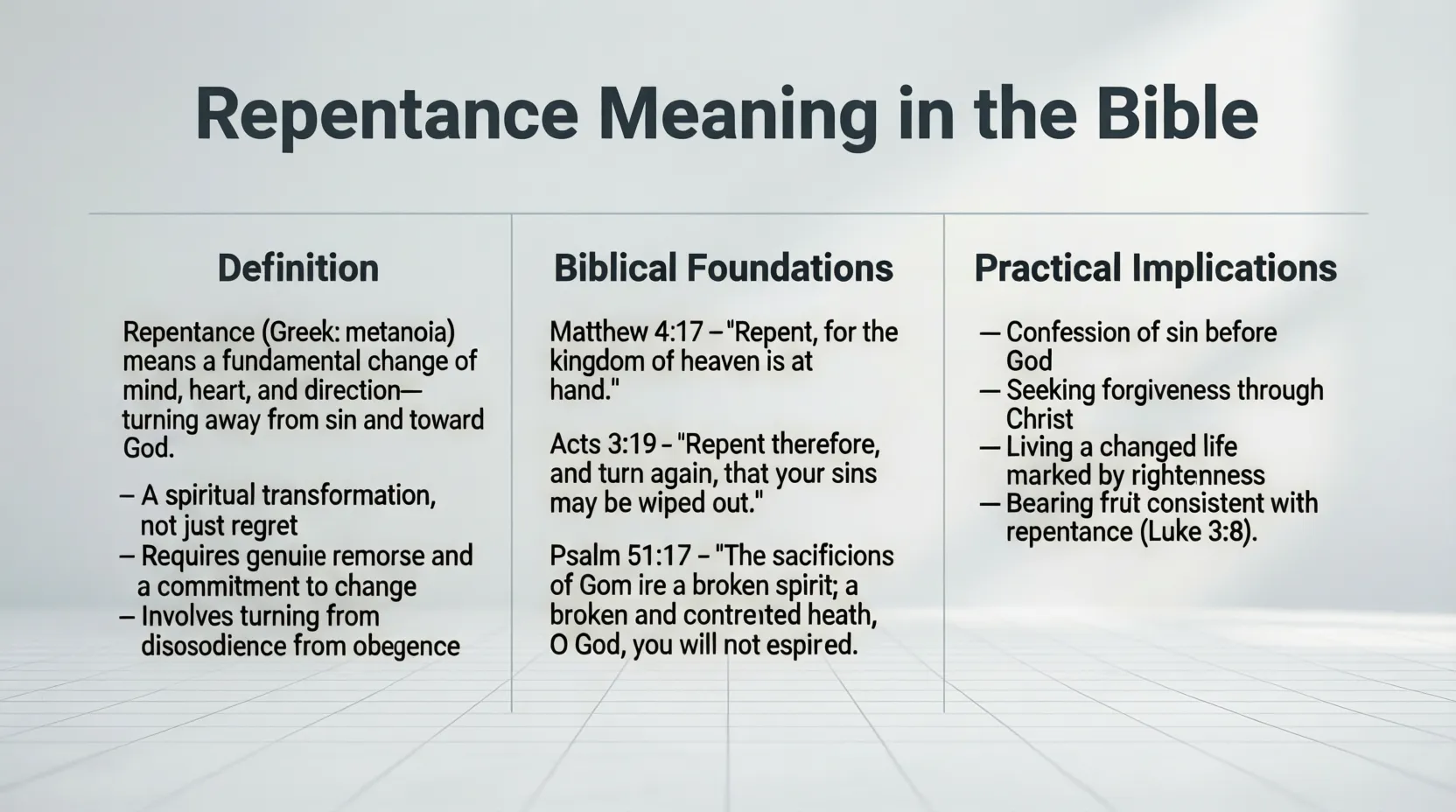
In the Bible, repentance means more than saying “I’m sorry.”
Repentance means:
- turning away from sin
- turning back to God
- changing your heart and direction
It is a spiritual transformation.
1. Repentance Means a Change of Heart
The word “repent” in the New Testament comes from the Greek word metanoia.
It means:
a change of mind and heart
Repentance is when God helps you see sin differently.
You no longer want it.
You want Him.
“Godly sorrow brings repentance that leads to salvation.”
— 2 Corinthians 7:10
This is not worldly guilt.
It is holy sorrow that brings healing.
2. Repentance Means Turning Back to God
Repentance is like turning around after walking the wrong way.
God does not just want you to feel bad.
He wants you to return.
“Repent… and turn to God, so that your sins may be wiped out.”
— Acts 3:19
Repentance is not running away from God.
It is running toward Him.
3. Repentance Is the Beginning of New Life
Jesus began His ministry with one clear message:
“Repent, for the kingdom of heaven has come near.”
— Matthew 4:17
Repentance is not the end.
It is the beginning.
It opens the door to:
- forgiveness
- spiritual renewal
- deeper faith
4. Repentance Brings Forgiveness
One of the most comforting truths in the Bible is this:
God forgives those who repent.
“If we confess our sins, He is faithful and just to forgive us.”
— 1 John 1:9
God is not waiting to reject you.
He is ready to restore you.
5. Repentance Is a Daily Walk
Repentance is not only a one-time moment.
It is a lifestyle of humility.
A daily choice to follow Jesus.
“Create in me a clean heart, O God.”
— Psalm 51:10
True repentance keeps your heart soft before God.
Spiritual Significance of Repentance
Repentance is one of the greatest gifts of grace.
1. Repentance Leads to Freedom
Sin brings heaviness.
Repentance brings release.
God does not want you trapped.
He wants you free.
2. Repentance Restores Peace
When you return to God, peace returns too.
Repentance removes the wall between you and Him.
3. Repentance Brings Spiritual Growth
Every time you repent, you grow stronger in faith.
You become more like Christ.
Repentance in Real Life and Faith Journey
Repentance may look like:
- admitting you were wrong
- asking God for mercy
- letting go of harmful habits
- choosing obedience again
- returning to prayer
It is not perfection.
It is surrender.
God honors a heart that comes back.
Practical Lessons and Faith Insights
If God is calling you to repentance today:
- don’t be afraid
- don’t delay
- come honestly
- trust His mercy
Repentance is not God pushing you away.
It is God inviting you closer.
Conclusion
The repentance meaning in the Bible is simple and powerful:
turn away from sin and return to God.
It is not about shame.
It is about grace.
God’s arms are always open.
No matter how far you’ve wandered, repentance is the path back to hope, peace, and new life in Christ.
God is ready to forgive. Come home.