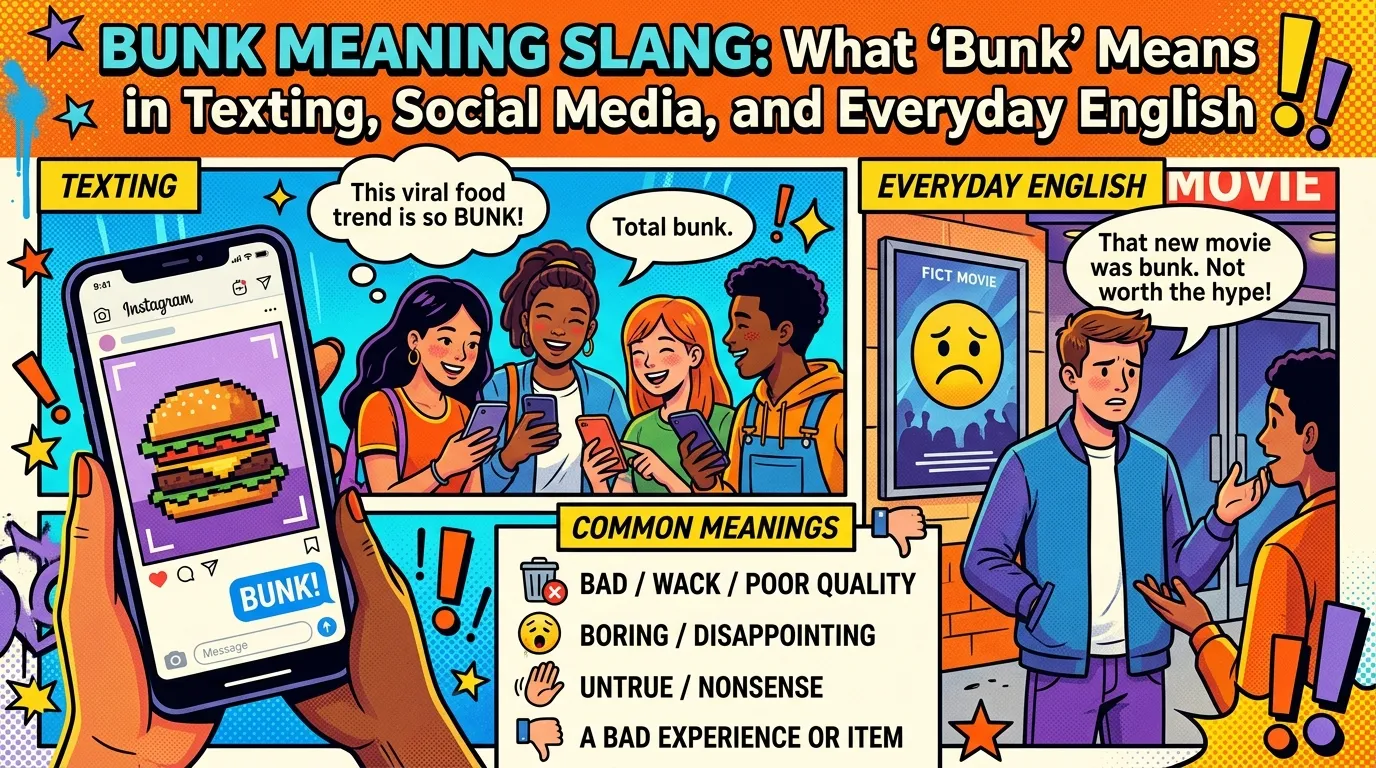
Bunk is a slang word that usually means nonsense, fake information, lies, or something that is not worth believing. If someone says, “That story is bunk,” they mean the story is false, ridiculous, or unreliable. In some situations, especially in British English, bunk can also mean to skip school or leave without permission, while in American English it can refer to a bunk bed or sleeping space.
The slang meaning can be confusing because bunk has several different meanings depending on context. You might see it in a text message, Reddit comment, TikTok caption, gaming chat, or casual conversation. For example, “That excuse is bunk” means the excuse is not believable, while “I bunked class” means someone skipped class.
Understanding bunk meaning slang is useful because the word can sound humorous, dismissive, or slightly insulting depending on how it is used. It is also closely related to expressions such as BS, nonsense, garbage, rubbish, fake, bogus, and baloney.
This guide explains what bunk means in modern slang, where the word came from, how people use it online, what it means in texting, and how it differs from similar expressions.
What Does “Bunk” Mean in Slang?
In slang and informal English, bunk means something that is nonsense, untrue, fake, or of poor quality.
When a person calls something bunk, they are saying they do not believe it or do not consider it worthwhile.
For example:
- “That rumor is bunk.”
- “His excuse sounds like bunk.”
- “The whole story was bunk.”
- “Don’t believe that post. It’s complete bunk.”
In these examples, bunk works much like nonsense or bullshit, although bunk is generally milder and less vulgar.
Simple definition
Bunk = nonsense, false information, an untrue claim, or something considered worthless or unreliable.
The exact meaning depends on the sentence. Someone could use bunk to criticize an argument, a rumor, an excuse, a product claim, or even a piece of advice.
Quick Answer: Bunk Meaning Slang
| Feature | Meaning |
|---|---|
| Slang meaning | Nonsense, lies, fake information, or something unreliable |
| Tone | Informal, dismissive, sometimes humorous |
| Common use | Calling a claim, story, excuse, or idea false |
| Similar words | Nonsense, bogus, baloney, rubbish, garbage |
| Stronger equivalent | BS or bullshit |
| Texting meaning | Usually “that is nonsense” or “that isn’t true” |
| British slang meaning | To skip school or leave without permission |
| Other meaning | A sleeping place or bunk bed |
| Typical phrase | “That’s bunk.” |
Why Do People Say “That’s Bunk”?
The expression “That’s bunk” is a short way of rejecting something.
Imagine a friend tells you:
“Drinking this special drink will make you instantly smarter.”
You might respond:
“That’s bunk.”
You are not necessarily saying the person is lying on purpose. You are saying that the claim itself is nonsense or has no credibility.
The expression is especially useful when someone wants to dismiss an idea without using a stronger or more offensive word.
“Bunk” can describe different things
You can call these things bunk:
- A false rumor
- A ridiculous story
- A weak excuse
- A misleading advertisement
- A fake claim
- Bad advice
- An unbelievable explanation
- An unreliable theory
- A made-up fact
For example:
“His explanation was bunk.”
This means his explanation was not convincing or truthful.
What Does Bunk Mean in Texting?
In texting, bunk usually means nonsense, fake, or untrue.
Because texting is informal, people may use short expressions such as:
- “That’s bunk.”
- “Total bunk.”
- “Nah, that’s bunk.”
- “This is bunk lol.”
- “That excuse is bunk.”
- “Bro, that’s bunk 😂.”
The meaning is usually clear from context.
Texting example
Person 1:
“I heard our school is closing tomorrow.”
Person 2:
“That’s bunk. The teacher just said we have class.”
Here, bunk means false information.
Another example
Person 1:
“He says he won the competition without even entering.”
Person 2:
“Sounds like bunk to me.”
The speaker doubts the story.
What Does Bunk Mean on TikTok and Instagram?
On social media, bunk can be used when someone thinks a video, claim, story, or comment is fake or ridiculous.
For example, someone might comment:
“This is bunk.”
That could mean:
- The information is false.
- The creator is exaggerating.
- The claim is ridiculous.
- The video is misleading.
- The person does not believe what they are seeing.
However, bunk is not necessarily one of the dominant slang terms on every social platform. Its use varies by age, region, community, and individual style.
You may encounter stronger or newer expressions such as cap, fake, BS, or misinformation more often in some online communities.
Bunk vs. “cap”
These words can overlap.
“That’s cap” generally means:
“That’s a lie” or “That isn’t true.”
“That’s bunk” generally means:
“That’s nonsense” or “That claim is worthless or unbelievable.”
For example:
- “He said he owns ten sports cars. That’s cap.”
- “That entire theory is bunk.”
The first focuses more directly on lying or falsehood. The second can focus on nonsense or lack of credibility.
What Does Bunk Mean on Snapchat?
On Snapchat, bunk generally carries the same informal meaning.
If someone sends you a questionable story and you reply:
“Bunk 😂”
you are basically saying:
“I don’t believe that.”
The word may also appear in group chats when someone makes an exaggerated claim.
For example:
Friend:
“I finished the whole project in five minutes.”
You:
“Bunk 😭”
This means you think the claim is unbelievable.
What Does Bunk Mean on Reddit?
Reddit users may use bunk to describe misinformation, weak arguments, questionable claims, or nonsense.
For example:
“That explanation is bunk.”
The speaker is dismissing the explanation rather than necessarily attacking the person.
Because Reddit contains many different communities, the tone can range from playful to strongly critical.
A commenter might say:
“That source is bunk.”
Here, they mean the source is unreliable or not credible.
Another user might say:
“This whole theory is bunk.”
That means the user believes the theory has little or no validity.
What Does Bunk Mean in Gaming?
In gaming chat, bunk can mean that something is bad, fake, unfair, unreliable, or nonsense, depending on the community.
For example:
Player 1:
“The enemy only won because their weapon is secretly unbeatable.”
Player 2:
“That’s bunk. You just played badly.”
Here, bunk means a weak or unconvincing explanation.
A player could also use it jokingly:
“Bro, that excuse is bunk.”
The meaning remains close to nonsense.
However, gaming slang changes quickly, so other words may be more common in a particular game or community.
What Does Bunk Mean in Dating?
In dating conversations, bunk may describe a bad excuse, fake story, or unbelievable explanation.
For example:
Person A:
“He said he couldn’t text because his phone disappeared for three days.”
Person B:
“That sounds bunk.”
Here, the speaker thinks the explanation is suspicious.
Another example:
“That dating advice is bunk.”
This means the person thinks the advice is bad, unrealistic, or unsupported.
Is “bunk” insulting?
It can be.
Calling someone’s statement bunk challenges the truth or quality of what they said. However, it is usually less aggressive than directly calling someone a liar.
Compare:
- “That sounds bunk.” — relatively mild
- “That’s nonsense.” — direct
- “You’re lying.” — personal and stronger
- “That’s bullshit.” — much more vulgar
Your tone and relationship with the other person matter.
What Does Bunk Mean in British English?
British English gives bunk another important slang meaning.
In informal British usage, to bunk off means to skip school, work, or another obligation without permission.
For example:
“They bunked off school.”
This means:
“They skipped school.”
You may also hear:
- “bunk off school”
- “bunk class”
- “bunked off work”
This meaning is different from the American slang meaning of bunk as nonsense.
Example
British usage:
“We bunked off school and went to the park.”
Meaning: They skipped school.
Nonsense usage:
“That story is bunk.”
Meaning: The story is nonsense or untrue.
Context tells you which meaning is intended.
Where Did the Word “Bunk” Come From?
The history of bunk is interesting because its different meanings developed through different uses.
The noun bunk meaning a sleeping berth or sleeping place has been used in American English for centuries and is associated with practical sleeping spaces such as those found on ships, trains, dormitories, and shared rooms.
The slang sense meaning nonsense is commonly connected with the expression “bunkum” or “buncombe.” The word became associated with empty political speech and insincere talk in the United States during the 19th century.
Over time, bunkum was shortened to bunk, and the word developed the broader meaning of nonsense or empty talk.
That historical connection helps explain why bunk can mean something that sounds impressive but has little truth or substance behind it.
How the Meaning of Bunk Evolved
The word has developed several distinct meanings.
1. Bunk as a sleeping space
A bunk can mean a bed or sleeping place, especially in a shared or compact space.
Example:
“I slept in the top bunk.”
2. Bunk as nonsense
In informal English:
“That claim is bunk.”
Meaning:
“That claim is nonsense.”
3. Bunk as skipping something
In British informal English:
“They bunked off class.”
Meaning:
“They skipped class.”
These meanings may look unrelated, but they are well established in different contexts.
Bunk Meaning: Nonsense vs. Fake vs. Bad
The slang word bunk can cover several related ideas, but these ideas are not identical.
Bunk = nonsense
When someone says:
“That idea is bunk.”
they may simply mean the idea makes no sense.
Bunk = false
If someone says:
“That story is bunk.”
they probably mean they believe the story is untrue.
Bunk = unreliable
If someone says:
“That website is bunk.”
they may mean the website provides unreliable information.
Bunk = worthless
Sometimes bunk suggests that something has little value.
For example:
“That product’s promises are bunk.”
The speaker is criticizing the claims surrounding the product.
Bunk vs. Similar Slang Words
Understanding similar words makes it easier to recognize the exact tone.
| Word | Basic meaning | Tone |
|---|---|---|
| Bunk | Nonsense or unreliable information | Informal |
| Nonsense | Something foolish or untrue | Mild |
| Bogus | Fake or not genuine | Informal |
| Baloney | Nonsense or an untrue claim | Playful/mild |
| Rubbish | Nonsense or poor-quality material | Common in British English |
| Garbage | Worthless or nonsensical | Informal |
| Cap | A lie or false statement | Modern slang |
| BS | Nonsense or dishonest talk | Informal/vulgar abbreviation |
| Bullshit | Complete nonsense or lies | Vulgar |
| Fake | Not genuine or authentic | Neutral/informal |
Bunk vs. nonsense
These are very close.
“That is nonsense.”
and
“That is bunk.”
can often communicate the same idea.
However, bunk can have a slightly old-fashioned or humorous flavor in some contexts.
Bunk vs. bogus
Bogus usually emphasizes that something is fake or fraudulent.
Bunk more often emphasizes that something is nonsense or unconvincing.
Compare:
“That certificate is bogus.”
The certificate may be fake.
“That explanation is bunk.”
The explanation may be nonsense.
Positive and Negative Connotations of “Bunk”
Most uses of bunk are negative.
When you call something bunk, you are rejecting it.
However, the word can sound playful rather than hostile, particularly among friends.
For example:
“Your excuse is bunk 😂.”
This could be friendly teasing.
The same phrase said during a serious argument could sound dismissive.
Tone depends on context
Playful:
“Bro, that excuse is bunk 😂.”
Serious:
“The report’s central claim is bunk.”
Critical:
“That article contains a lot of bunk.”
The word itself does not determine the exact emotional tone. The surrounding language does.
Common Phrases Using “Bunk”
Here are some useful expressions:
“That’s bunk.”
Means:
“That’s nonsense.”
“Complete bunk”
Means:
“Complete nonsense.”
Example:
“The rumor was complete bunk.”
“Total bunk”
A stronger informal version.
“His explanation was total bunk.”
“Sounds like bunk”
Shows doubt.
“That sounds like bunk to me.”
“Bunkum”
A longer and somewhat old-fashioned form meaning nonsense or empty talk.
“Bunk off”
In British English, this means to skip an obligation.
“They bunked off school.”
Real-Life Conversation Examples
Example 1: A rumor
Alex: I heard the company is shutting down next month.
Sam: That’s bunk. The manager said we’re expanding.
Here, bunk means false information.
Example 2: An excuse
Mom: Why didn’t you finish your homework?
Son: My pencil stopped working.
Mom: That’s bunk. You have six pencils.
Here, bunk means an unbelievable excuse.
Example 3: Online discussion
User 1: This supplement guarantees instant results.
User 2: That claim sounds like bunk.
The speaker doubts the claim.
Example 4: Friends joking
Mike: I can run faster than anyone here.
Jake: Bunk 😂
The word is being used playfully to challenge the claim.
Example 5: British school slang
Tom: Where were you yesterday?
Ben: We bunked off school.
Here, bunked off means skipped school.
Common Mistakes When Using “Bunk”
Because bunk has several meanings, learners can misunderstand it.
Mistake 1: Assuming bunk always means a bed
A bunk can mean a sleeping place, but in:
“That story is bunk.”
it does not mean a bed.
Mistake 2: Assuming bunk always means “lie”
Calling something bunk does not always accuse someone of deliberately lying.
It can simply mean:
- foolish
- unsupported
- unreasonable
- unreliable
- nonsensical
Mistake 3: Confusing “bunk” with “bunk bed”
A bunk bed is a type of bed with sleeping spaces arranged vertically.
A bunk can refer to one sleeping space.
But slang bunk means something entirely different.
Mistake 4: Ignoring regional differences
If you see:
“He bunked off school.”
the British slang meaning is probably intended.
If you see:
“That story is bunk.”
the meaning is probably nonsense or false information.
Is “Bunk” Still Used Today?
Yes, but its popularity depends heavily on the context and speaker.
The nonsense meaning remains recognizable in American English, especially in phrases such as:
- “That’s bunk.”
- “Complete bunk.”
- “Bunkum.”
- “That claim is bunk.”
However, younger speakers may choose newer slang such as cap, fake, or BS, especially online.
That does not make bunk incorrect or obsolete. It simply means that slang preferences change over time.
In modern communication, context is particularly important because online language combines regional slang, older expressions, memes, abbreviations, and rapidly changing vocabulary.
Is “Bunk” a Bad Word?
No. “Bunk” is not generally considered a swear word.
It is a relatively mild informal expression.
However, it can still sound rude if you use it to dismiss someone’s serious opinion.
For example:
“Your argument is bunk.”
could sound disrespectful during a formal discussion.
In professional writing, alternatives such as unsupported, inaccurate, unsubstantiated, or incorrect may be more appropriate.
Can You Use “Bunk” at Work?
You can, but be careful.
In casual workplace conversation, someone might say:
“That sounds like bunk.”
But in a formal email, it is usually better to write:
“That claim does not appear to be supported by the available evidence.”
This is more professional and precise.
Informal workplace conversation
“I think that explanation is bunk.”
Professional alternative
“I don’t think that explanation is supported by the evidence.”
The second version avoids sounding dismissive.
How to Use “Bunk” Naturally
If you want to use the word correctly, focus on context.
Use bunk when you want to communicate that something is:
- nonsense
- unbelievable
- unreliable
- unsupported
- fake
- empty talk
Natural examples
- “That rumor is bunk.”
- “His excuse sounds bunk.”
- “Don’t fall for that bunk.”
- “The whole story was bunk.”
- “That’s complete bunk.”
- “I think that claim is bunk.”
Avoid using it when you need to make a precise factual statement. If something is demonstrably false, false, incorrect, or inaccurate may communicate your meaning more clearly.
What Does “Bunk” Mean in Different Contexts?
| Context | Likely meaning | Example |
|---|---|---|
| Texting | Nonsense/fake | “That’s bunk.” |
| TikTok | False or ridiculous claim | “This video is bunk.” |
| Unbelievable information | “That story is bunk.” | |
| Snapchat | Doubt or disbelief | “Bunk 😂” |
| Unreliable argument/information | “That claim is bunk.” | |
| Gaming | Bad or unconvincing explanation | “That excuse is bunk.” |
| Dating | Suspicious or unbelievable excuse | “That sounds bunk.” |
| Workplace | Unsupported claim | “That idea is bunk.” |
| British school slang | Skip school | “They bunked off.” |
| Bedroom/travel | Sleeping place | “I took the top bunk.” |
Frequently Asked Questions About Bunk Meaning Slang
1. What does “bunk” mean in slang?
In slang, bunk usually means nonsense, false information, an unbelievable story, or something unreliable. For example, “That excuse is bunk” means the speaker does not believe the excuse.
2. Is “bunk” the same as “bullshit”?
They can have similar meanings, but bunk is much milder. Both can describe nonsense or false claims, while bullshit is vulgar and more aggressive.
3. What does “that’s bunk” mean?
“That’s bunk” means “that’s nonsense,” “that isn’t believable,” or “that claim is false or unreliable.” The exact meaning depends on context.
4. What does bunk mean in texting?
In texting, bunk usually means nonsense or something the sender does not believe. A reply such as “Bunk 😂” may simply mean “I don’t believe you.”
5. What does bunk mean on social media?
On social media, bunk can describe fake, misleading, ridiculous, or unreliable content. It may be used to dismiss a post, claim, rumor, or explanation.
6. Is bunk British slang?
Yes. In British informal English, “bunk off” means to skip school, work, or another obligation. This is different from the American informal meaning of bunk as nonsense.
7. Does bunk mean lie?
Sometimes, but not always. Calling something bunk can mean it is false or untrue, but it can also mean it is simply nonsense, poorly supported, or unbelievable.
8. Is bunk a swear word?
No. Bunk is not generally considered profanity. It is an informal word that can sound dismissive depending on how it is used.
9. What is the opposite of bunk?
Depending on the context, possible opposites include truth, fact, evidence, genuine information, accurate information, or credibility.
10. What is another word for bunk slang?
Common alternatives include nonsense, bogus, baloney, rubbish, garbage, fake, cap, BS, and bullshit. The best alternative depends on how strong or informal you want to sound.
Final Takeaway: What Does “Bunk” Mean?
So, what does bunk mean in slang?
Most often, bunk means nonsense, false information, an unbelievable claim, or something considered unreliable or worthless. If someone says “That’s bunk,” they are essentially saying, “That’s nonsense” or “I don’t believe that.”
The word can appear in texting, social media discussions, Reddit comments, gaming conversations, dating chats, and everyday speech. Its tone can be playful or dismissive depending on the situation.
Remember that bunk has other meanings, too. A bunk can be a sleeping space, while bunk off is British slang for skipping school or another obligation.
The safest way to understand the word is to look at the surrounding sentence. When bunk describes a story, claim, excuse, rumor, or idea, it usually means nonsense or something not worth believing. When it appears in “bunk off,” it usually refers to skipping something.
In short, bunk is a mild, flexible slang term for calling something untrue, foolish, or unreliable without using harsher language.